


Blanking Panels: A Small Component with a Big Impact on Cabinet Cooling
In our project experience, when Spring’s engineering team works with customers on data center or Telecom site design, attention naturally goes to major systems such as cooling units, power equipment, batteries and monitoring. However, the internal structure of the cabinet is also important to real-world performance.
Table of Contents
Toggle
for example, in an air-cooling data center rack, an unused opening can allow hot exhaust air to return to equipment intakes or let cold supply air bypass the load. To address this, Spring’s engineers consider the actual equipment configuration inside the cabinet and select suitable blanking-panel solutions for the application. By closing unused rack or module positions, blanking panels help guide airflow along its intended path. This small component should therefore be considered as part of the overall thermal-management design, rather than as an afterthought during installation.
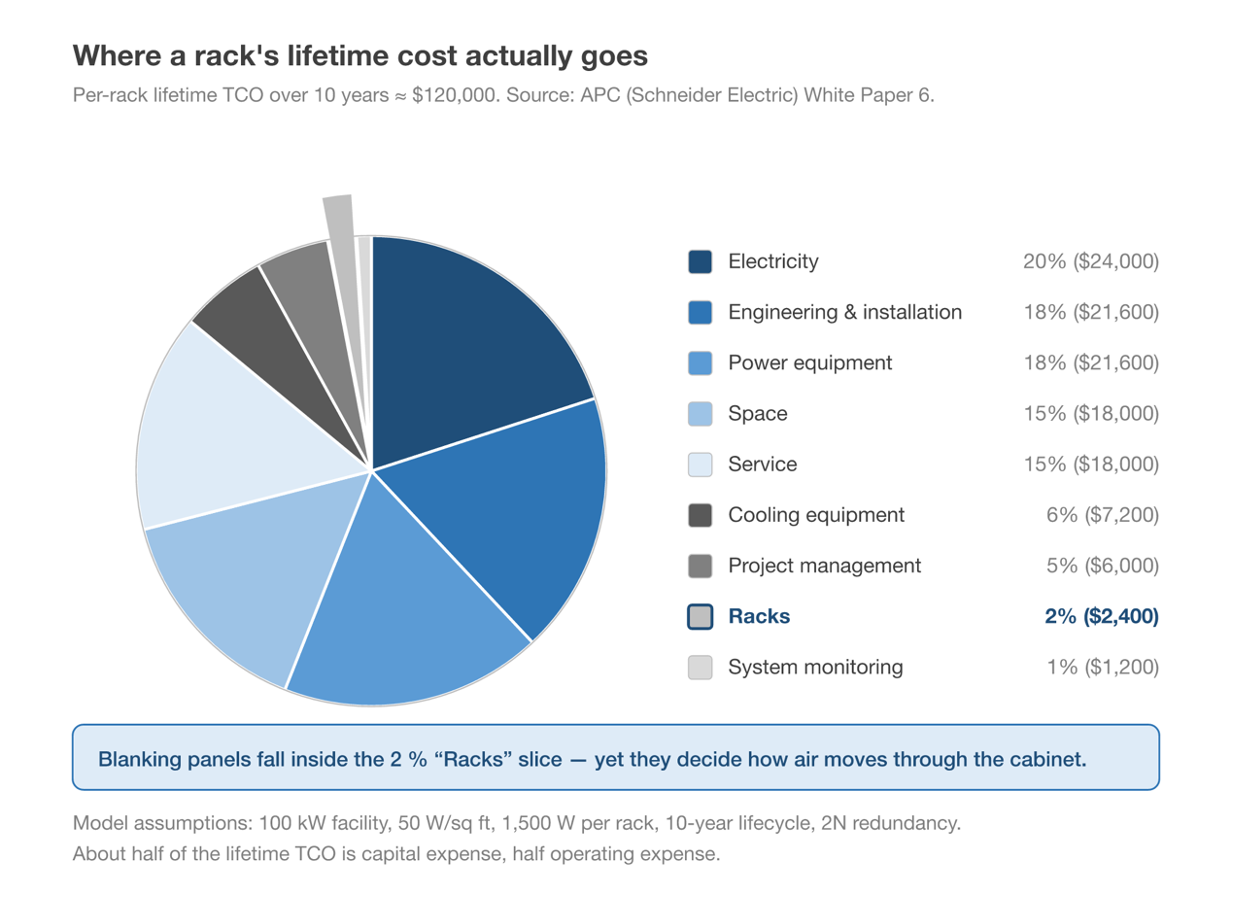
Why open rack slots matter
During the operation of a data center rack, leaving openings uncovered can lead to two common airflow problems:
- Hot-air recirculation. Warm exhaust from operating servers or network equipment can loop around and return to nearby intakes, raising inlet temperatures and potentially increasing fan demand.
- Cold-air bypass. Conditioned air may pass through unused openings or around equipment without cooling the intended load, reducing the effectiveness of the cooling system.
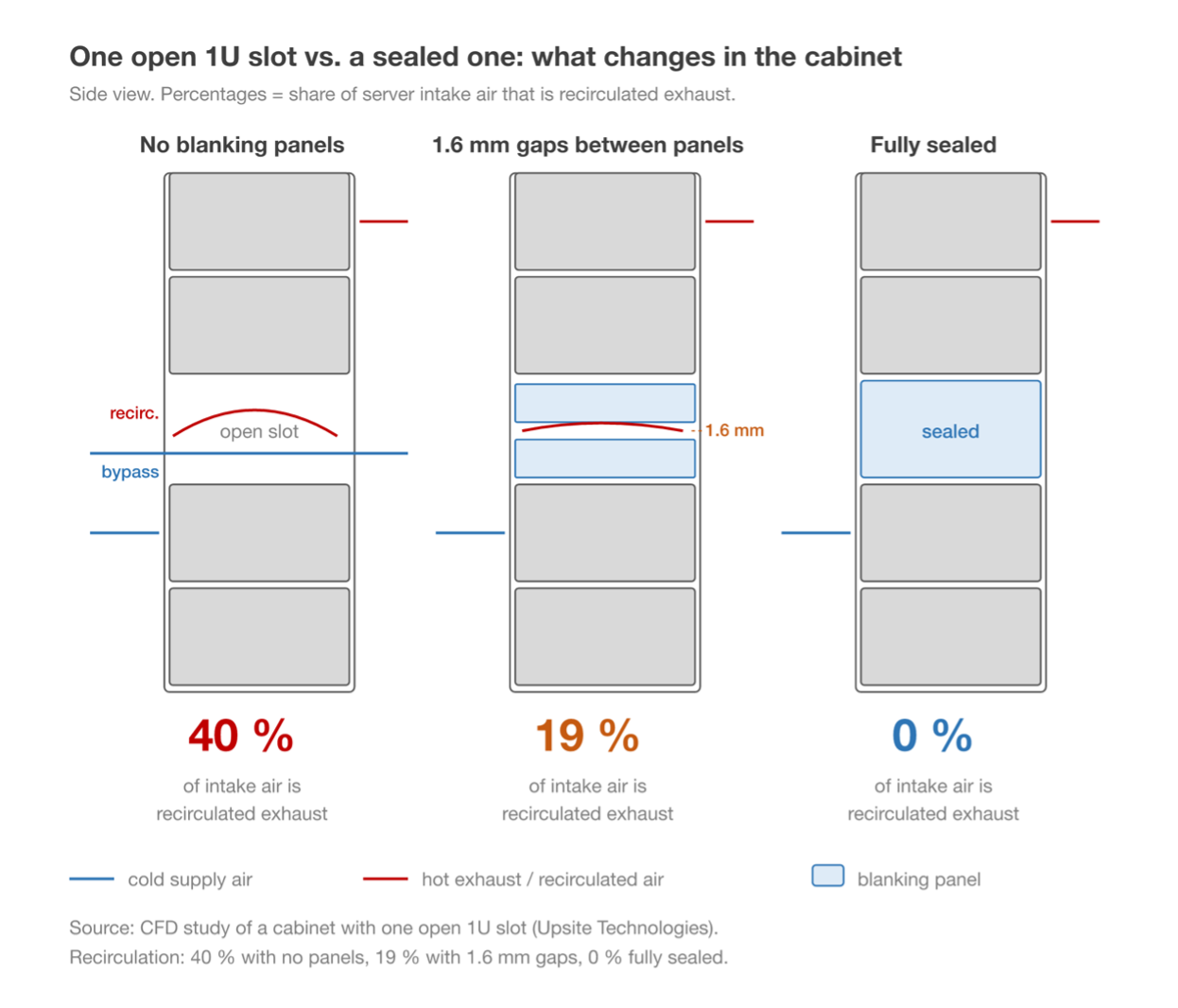
The size of the effect depends on the rack layout and cooling architecture. In a computational fluid dynamics (CFD) comparison from Upside Technologies cited in the source material, approximately 40% of intake air was reported as recirculated exhaust when no blanking panels were installed. With a 1.6 mm gap, the figure fell to 19%; in the fully sealed model, it fell to 0%. These figures illustrate the importance of fit and sealing in that model and should not be treated as a guaranteed result for every facility.
How to choose the right blanking panel
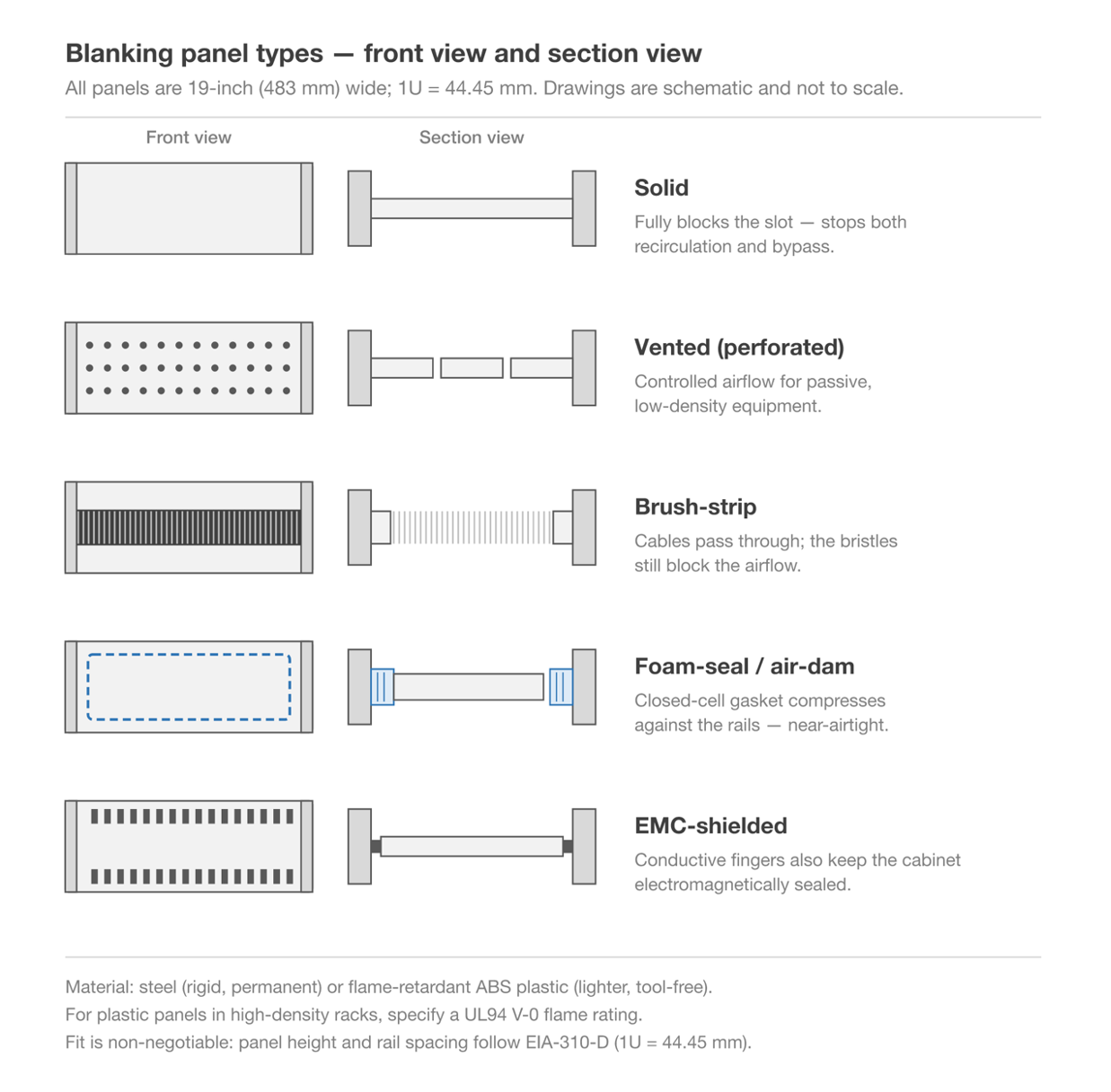
The best panel is the one that matches the airflow strategy, cable routing and equipment requirements of the cabinet. Common options include:
- Solid panels. A straightforward choice for unused slots where no cables need to pass through.
- Vented or perforated panels. Allow some air passage when a controlled opening is part of the system design. They should not be used as a substitute for a solid seal where full separation is required.
- Brush-strip panels. Allow cables to pass through while limiting the size of the open path around them.
- Foam-seal or air-dam panels. Use a compressible gasket to help close gaps around the panel where tighter airflow separation is needed.
- EMC-shielded panels. Provide electromagnetic shielding where required by the application, alongside the relevant cabinet design requirements.
Fit and installation matter as much as panel selection
We have seen in industry discussions that some operators purchase blanking panels after deployment to improve the performance of their existing cabinets. Retrofitting can be a practical improvement, but the result depends on the cabinet design, the panel fit and the installation quality. A panel only helps when it fits the rack and is installed consistently. We recommend reviewing the following points before commissioning—and again after equipment changes:
- Cover every unused position. A single missed slot can become an easy airflow path in an otherwise well-managed rack.
- Check the edges. A panel that leaves visible gaps may limit the benefit of closing the opening. Confirm compatibility with the rack rails and the selected panel size.
- Plan for cable routes. Use an appropriate brush or purpose-designed pass-through where cabling crosses the rack face, and seal cable-entry openings according to the cabinet design.
- Recheck after changes. Moves, adds and changes (MACs) can leave new openings. Include blanking coverage in routine cabinet and airflow reviews.
Good airflow management is a system practice. Blanking panels can complement containment and a well-designed cooling strategy, but they do not replace appropriate capacity planning, equipment layout or site-specific thermal assessment.
The same principle applies to telecom power and battery cabinets
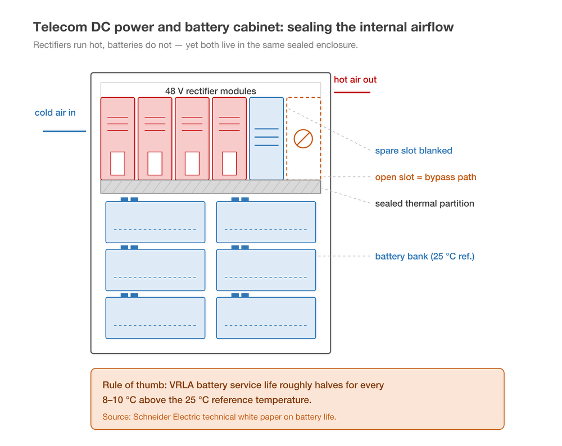
Telecom enclosures may house rectifier modules, power electronics and batteries in the same cabinet. Empty module positions can create unintended airflow paths, while inadequate separation between warmer electronics and temperature-sensitive batteries can make thermal management more difficult.
The cabinet design should account for spare module slots, partition openings, cable entries and the intended cooling path. Properly designed partitions and sealed openings help keep air directed where it is needed. Battery temperature limits and compartment arrangements should always follow the battery and equipment manufacturers’ requirements.
Outdoor enclosures need the same attention to detail
Outdoor telecom cabinets often use air conditioners or heat exchangers to manage internal temperatures while limiting the entry of dust, moisture and pollutants. In these designs, unplanned openings around unused module positions or cable entries can compromise the intended airflow path—and, depending on the cabinet construction, may also affect environmental protection.
When specifying an outdoor enclosure, review the full configuration: cooling method, cable-entry sealing, separation between compartments, spare module positions and maintenance access. The target is not simply to close every opening indiscriminately; it is to preserve the engineered airflow and protection strategy of the complete cabinet.
How Ningbo Spring approaches cabinet-level thermal management
At Ningbo Spring System Integration, we design customized indoor server racks and outdoor telecom enclosures, with cooling-system integration tailored to project requirements. Our approach considers the cabinet as a complete system—enclosure layout, equipment arrangement, cooling, cable routing and service access—so these decisions can be coordinated during specification rather than left until installation.
With more than 25 years of industry experience and a 40,000 m² in-house production base, Spring supports customized cabinet and system-integration projects for telecom, energy storage and data center applications. For projects where thermal performance is critical, early coordination between enclosure design and cooling requirements can help teams reduce avoidable airflow issues and create a more maintainable cabinet configuration.
Key takeaways
- Blanking panels help limit hot-air recirculation and cold-air bypass through unused rack openings.
- Panel fit and complete coverage matter; even small gaps can affect airflow in a given configuration.
- Choose the panel type according to airflow strategy, cable routing and any shielding requirements.
- Include rack slots, module positions, cable entries and internal partitions in cabinet-level thermal planning.
- Recheck coverage after equipment changes, and evaluate blanking panels as one element of the overall cooling design.
Related Products