



Cell Tower
Tower sites are the backbone of wireless networks, providing wide area coverage for high-mobility users. Cell phone towers, also known as base stations, house electronic equipment and antennas that send and receive signals to and from cell phones. These structures are essential for maintaining reliable communication, ensuring that users can make calls, send texts, and access the internet seamlessly.
With the expansion of 5G technology, the importance of cell phone towers continues to grow, as they are integral to delivering faster data speeds and supporting the increasing demand for wireless communication.

How Do Cell Towers Work?
The cell towers are equipped with antennas that transmit and receive radio frequency (RF) signals. When you make a call, send a text, or use data on your cell phone, your device converts your voice or data into an RF signal, which is transmitted to the nearest cell tower. The tower’s base station receives and processes the signal, then routes it through the telecommunications network to a mobile switching center (MSC). The MSC connects cell towers to the broader telephone network or the internet and ensures seamless handoff between towers as you move.
When you receive a call, text, or data, the process is reversed. The MSC routes the incoming signal to the appropriate base station, which transmits it to the antennas. These antennas then send the RF signal to your device, where it is decoded back into voice, text, or data. The area covered by a cell tower is called a cell, and multiple towers create a network of cells for broad coverage. Towers manage network capacity by dynamically adjusting resources based on demand, ensuring users have sufficient bandwidth.
Advanced features like Multiple Input Multiple Output (MIMO) and beamforming enhance data transmission rates and signal strength, respectively. With the rollout of 5G, smaller cell towers (small cells) are being deployed to provide dense coverage and high data rates. Additionally, 5G towers may incorporate edge computing to process data closer to the user, reducing latency. By facilitating the transmission and reception of RF signals, cell towers enable seamless wireless communication, supporting everything from voice calls to high-speed internet access.
Typical Cell Tower Components
A cell tower, also known as a base station, is composed of various essential components that work together to enable wireless communication.
The physical site is the foundation, housing the infrastructure needed to support the tower. The mast, or tower structure, elevates the antennas to optimize signal coverage.
Antennas are critical for transmitting and receiving signals. Panel antennas handle broad coverage, while microwave antennas facilitate point-to-point communication between towers.
The rack or shelter contains the telecom equipment, including radio transmitters and receivers that process the signals. Batteries provide backup power to ensure continuous operation during outages, complemented by cooling systems to maintain optimal temperatures for the equipment.
Generators serve as an additional power backup to sustain the tower during extended power failures.
These components work in concert to maintain seamless and reliable wireless communication, ensuring that users stay connected.

What are the Common Challenges in Maintaining Cell Towers?
Maintaining cell towers involves navigating numerous challenges. These include the impact of harsh weather conditions such as high winds, heavy rain, and lightning, which can damage tower components and pose risks to maintenance personnel. Accessibility is another significant hurdle, as many towers are located in remote or challenging terrain, requiring specialized equipment and transport to reach them safely. Safety remains paramount due to the inherent risks of working at heights and handling electrical equipment.
Additionally, interference from environmental factors and other electronic devices must be monitored and managed to ensure consistent signal quality.
Vandalism and theft are ongoing concerns, particularly for valuable components like copper cables and batteries.
Aging infrastructure necessitates regular upgrades to maintain performance, while compliance with regulatory standards adds complexity to operations.
Reliable power supply is crucial, often requiring backup systems such as batteries and generators.
Addressing these challenges ensures cell towers can meet the demands of modern telecommunications while minimizing downtime and service disruptions.
What We Can Offer for Cell Towers?
At Ningbo Spring System, we provide high-quality solutions to enhance the reliability and efficiency of cell towers. Our offerings include:
Outdoor Enclosures: Robust and durable enclosures designed to protect sensitive equipment in harsh outdoor environments. We offer a variety of material options and enclosure structures to cater to diverse environmental requirements. What’s more, these enclosures are integrated with batteries, cooling systems and monitoring systems to ensure continuous operation and optimal performance.
Indoor Cabinets and Racks: Customizable cabinets and racks for shelters, providing organized and secure housing for telecom equipment, ensuring easy access and maintenance.
With our comprehensive solutions, we aim to support the seamless operation and maintenance of cell towers, ensuring they deliver consistent and reliable service.
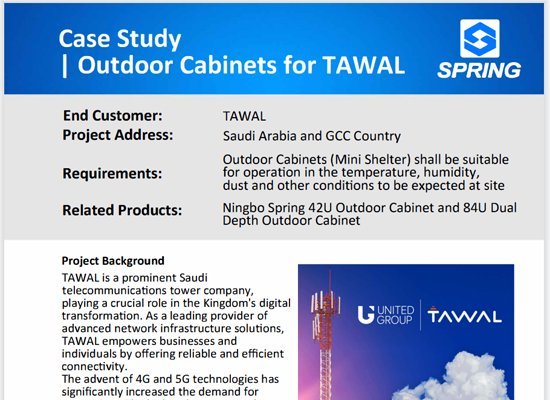
TAWAL is a prominent Saudi telecommunications tower company, playing a crucial role in the Kingdom’s digital transformation. As a leading provider of advanced network infrastructure solutions, TAWAL empowers businesses and individuals by offering reliable and efffcient connectivity.
The advent of 4G and SG technologies has significantly increased the demand for tower sites. The higher data rates and new applications enabled by these technologies necessitate denser network deployments. Shorter wavelengths associated with SG networks require more frequent cell site installations, while technologies like MIMO demand additional antennas and equipment. As a result, tower companies face increasing pressure to expand their infrastructure to meet the growing needs of telecommunications operators.
Related Products (2)
-

Ningbo Spring’s Indoor Network and Server Cabinet Series, crafted from high-quality SPCC, offer diverse options in dimensions and loading capacities.
-

Ningbo Spring System’s Outdoor Enclosures are engineered to endure harsh enviroment while delivering superior protection for active electronics across all environments.
Why Choose Us