




Illustrated title graphic for the article: "The 19-Inch Rack: The Global Standard and Universal Compatibility Behind a Single Number". Publication date: Jan 14th, 2026.

In data centers, enterprise server rooms, broadcast studios, and industrial control centers, one term is universally heard: the “19-inch rack.” It functions as a common language, enabling equipment from different manufacturers to be neatly organized and integrated. But have you ever stopped to wonder: Who defined this “19-inch” standard? What exact dimension does it refer to? And why is it so fundamentally crucial?

A composite image showing four application environments for 19-inch racks: a modern data center, an enterprise server room, a broadcast studio control panel, and an industrial control center.

Overview and History

  1. What Is It?
    A 19-inch rack is a standardized frame or enclosure designed to mount various electronic equipment modules. Devices built for this system are described as rack-mount (e.g., a rack-mount server, chassis, or subrack).

The standard is defined by two key dimensions:

  • Width: Equipment is designed to be 19 inches (482.6 mm) wide. This measurement refers to the distance between the mounting holes on the two vertical posts or “rails” of the rack.
  • Height: Equipment height is measured in multiples of a Rack Unit (U or RU). 1U equals 1.75 inches (44.45 mm). A common full-size rack cabinet is 42U tall.
  • Depth: Crucially, the 19-inch standard does not define a depth. This is a key variable. Both racks and equipment come in various depths (common ones include 600mm, 800mm, 1000mm, and 1200mm). Ensuring that the rack depth adequately accommodates the equipment’s depth—including necessary clearance for cabling and airflow—is an essential yet often overlooked factor in specification and planning.

2. Origin and Evolution

  • Early Use: The term “relay rack” first appeared in telephony and later in railroad signaling in the early 20th century, though these early racks lacked a uniform standard.
  • Standardization (1920s): The modern 19-inch, 1.75-inch-per-U standard was formally established by AT&T around 1922. The goal was to create a modular, space-efficient system for telephone repeater and termination equipment in central offices. AT&T’s specification called for panels mounted on “vertical supports spaced 19½ inches between centers,” with heights in whole multiples of 1¾ inches.
  • Codification: By 1934, it was an established industry standard. It has since been formally codified by bodies like the Electronic Industries Alliance (EIA). The technical definition of a “U” was refined to the exact 44.45 mm (1.75 in) we use today.
  1. Lasting Impact and Modern Use
    The 19-inch rack’s genius lies in its constant form factor adapting to radically changing technology. It created universal compatibility, allowing hardware from different manufacturers and eras to be integrated seamlessly.

Today, it is the dominant standard across numerous industries:

  • Information Technology: The backbone of enterprise data centers and server rooms, holding servers, switches, and storage.
  • Telecommunications: Found in central offices and network hubs.
  • Professional Audio/Video: Used for amplifiers, mixers, broadcast gear, and interfaces.
  • Industrial & Scientific: Houses control systems, automation hardware, and test equipment (e.g., oscilloscopes).
A composite image illustrating the widespread application of the 19-inch rack standard across four major industries: Information Technology (server racks in a data center), Telecommunications (network switchgear), Professional Audio/Video (broadcast mixing console), and Industrial & Scientific (control panel in an automation facility).

A Note on Installation: For smooth installation and removal, a rack-mount device’s front panel is typically 1/32 inch (0.79 mm) less than its nominal U height. For example, a 1U device is actually about 1.719 inches tall, not 1.750, allowing for necessary clearance.

The Empire of Compatibility: What Fits Inside a 19-Inch Rack?

The true power of the 19-inch standard lies in its universal compatibility. This single specification has created a vast, interoperable hardware ecosystem where equipment from any manufacturer can be seamlessly integrated, much like building blocks.

The Core Principle:
Any device designed to the 19-inch mounting hole width (465.12 mm / 18.312″ center-to-center) and a whole-unit “U” height multiple can be installed into a standard rack. This principle of mechanical interoperability is what drives industry efficiency.

A Glimpse into the Ecosystem:
Here is a non-exhaustive list of equipment types that adhere to this standard, powering our modern world:

  • Information Technology & Networking:
    • Servers: Dell PowerEdge, HPE ProLiant, Lenovo ThinkSystem, Cisco UCS.
    • Network Switches & Routers: Cisco Catalyst/Nexus, Juniper, Aruba, Ubiquiti.
    • Storage Arrays: Dell EMC PowerStore, NetApp, Synology RackStation.
    • Security Appliances: Palo Alto Networks firewalls, FortiGate.
  • Telecommunications:
    • Optical Terminals (OTNs), Fiber Distribution Panels (e.g., from Corning or CommScope), Voice Gateways, Network Interface Devices.
  • Professional Audio/Video & Broadcast:
    • Audio Mixers (e.g., Yamaha, Soundcraft), Amplifiers (Crown, QSC), Video Switchers (Blackmagic Design, Ross), Patchbays, and Broadcast Encoders/Decoders.
  • Industrial Control & Automation:
    • Programmable Logic Controller (PLC) Systems (Siemens, Rockwell Automation), Industrial PCs (Advantech), DIN Rail Converters, and Power Supplies.
  • Critical Supporting Infrastructure:
    • PDUs: Intelligent Power Distribution Units from vendors like APC by Schneider Electric, Vertiv, or Raritan.
    • KVM Switches: For centralized server access from brands like Aten or Raritan.
    • Cooling: Active fan trays and heat exchangers.
    • Cable Management: Vertical and horizontal cable organizers, fiber management panels.

This standardized framework ensures that whether you’re building a cloud data center, a broadcast truck, or an automated factory line, the physical integration of core hardware is a solved problem. The 19-inch rack is the silent, unifying platform that makes it all possible.

Exploring the Types of 19-Inch Racks

Racks share the 19-inch standard but come in distinct form factors to meet different needs.

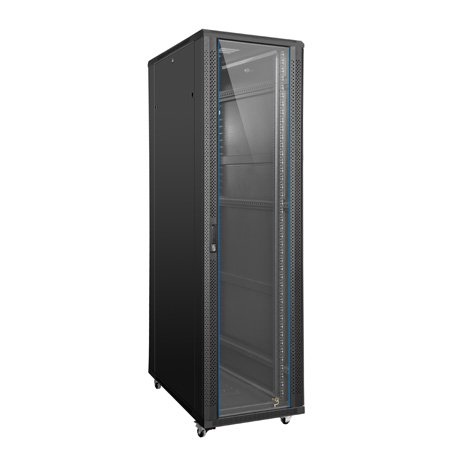
  1. Floor-Standing Cabinets
    Fully enclosed for security and environmental control.
  • Features: Four-post design with panels and doors, integrated cable management, often includes cooling and PDU support.
  • Use: Data centers, server rooms, and NOCs where security, dust control, noise reduction, and thermal management are essential.
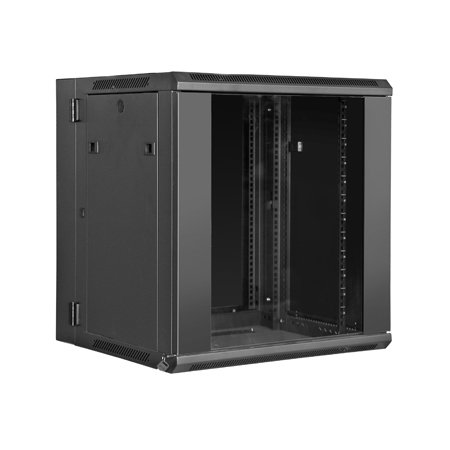
  1. Wall-Mount Cabinets
    Space-saving enclosures for mounting on walls.
  • Features: Compact, shallower depth, typically 6U-15U height.
  • Use: Network closets, small offices, retail, labs—ideal for switches, patch panels, and compact servers.
  1. Open Frame Racks
    Open structure for maximum accessibility and airflow.
  • Two-Post: Supports equipment from front only. Best for lightweight telecom/network gear like patch panels and switches.
  • Four-Post: Front and rear support for heavy, deep equipment like servers and storage. Provides stability and supports sliding rails.

How to Choose:

  • Security/Environment: Floor-standing cabinet
  • Space/Cost: Wall-mount or open frame
  • Access/Airflow: 4-post open frame
  • Heavy/Deep Equipment: 4-post; Lightweight Gear: 2-post

Selecting the right type ensures your rack fits both your equipment and its operating environment.

The Spring 19-Inch Indoor Rack System

At Spring, we believe true compatibility means providing infrastructure that fits your exact space, equipment, and operational needs. Our indoor rack system delivers this through extensive configurability and integrated accessories.

Fully Configurable Dimensions
Select the precise size for optimal space use:

  • Depth: Floor-standing cabinets come in 600–1200mm depths; wall-mount cabinets in 450–600mm profiles.
  • Height: Choose from 18U–47U for floor-standing models or 4U–27U for wall-mount units.

Complete Accessory Ecosystem
Build organized, functional racks with our compatible accessories:

  • Cooling: Fan trays and ventilation units for thermal management.
  • Cable Management: Vertical/horizontal managers and ducts for organized, accessible cabling.
  • Mounting: Fixed and sliding shelves for non-rackmount items.

Spring transforms the standard 19-inch rack into a fully optimized, deployment-ready platform for your critical hardware.


Extending the Standard Outdoors

While designed for custom, harsh-environment applications, most Spring outdoor cabinets also incorporate the universal 19-inch internal frame. This ensures seamless compatibility with standard rack-mount equipment, allowing you to deploy the same servers, switches, and controllers used indoors into weatherproof, secure outdoor enclosures—simplifying integration across your entire infrastructure.

From data centers to remote field installations, the 19-inch standard proves to be the enduring foundation of reliable and interoperable hardware mounting. At Spring, we build upon this foundation to deliver precision-engineered solutions for every environment.


Related Products

42U Network Cabinet
SQS Wall Mount Cabinets
Ningbo Spring adjustable depth 4 post open server rack frame for data center IT equipment
4 Post Open Frame

Other News & Insights

The "19-Inch" Rack
DC vs. AC Outdoor Air Conditioner for Cabinet Cooling
Axial Fan vs. Centrifugal Fan
Scroll to Top